
NOTE: This newsletter may contain outdated material. Please review the
Regulation Index and the What's New
pages to obtain the most recent versions of the Regulation information.
APRIL 1996
PLANS & STATISTICS
1-800-937-9247
ALL INFORMATION CONTAINED IN THIS NEWSLETTER IS SUMMARY
INFORMATION. PLEASE REFER TO THE REGULATIONS CITED FOR LEGAL DOCUMENTATION.
THIS NEWSLETTER PROVIDES ONLY A SUMMARY OF MANAGEMENT MEASURES ADOPTED BY THE
COMMISSION AND HAS NO LEGAL FORCE OR EFFECT. TO READ THE REQUIREMENTS IN THEIR
ENTIRETY, YOU ARE URGED TO OBTAIN A COMPLETE COPY OF THE REGULATIONS BY CALLING
DANA DOWLING AT 1-804-247-8067(LOCAL) OR 1-800-937-9247(LONG DISTANCE).
What is a pinger? How did pingers get to Virginia? What does a pinger look and sound like? Can I harvest pingers? Will pingers affect my harvest? Do I have to report pingers? Why would I be interested in a pinger? How can I find out more about pingers?
These are all valid questions that will be answered in the coming months. VMRC Fisheries Management staff will be conducting workshops to answer these questions. All interested individuals are encouraged to attend. A few individuals will be identified at the workshops to actually work with pingers in Virginia waters.
Now to address your curiosity. Essentially, pingers are "alarms", placed on nets, warning marine mammals of the presence of nets in the area. Pingers were originally designed by an animal behaviorist to reduce whale collisions with cod traps in Newfoundland. Since this time, pingers have been tested on gillnets in the Northeast gillnet fishery. Virtually any fishing gear having the potential for marine mammal interactions can now be fitted with pingers.
The Marine Mammal Protection Act, as amended, calls for reducing "incidental mortality and serious injury of marine mammals to insignificant levels approaching a zero mortality and serious injury rate". Fisheries have been classified according to their annual impact on marine mammal stocks. Amendment #5 to the groundfish plan has placed time/area closures to a 2500 square-mile block of ocean along the coast of Maine. Recently, fishing gear utilizing pingers have been allowed to fish in these closed areas.
These issues coupled with documented strandings of marine mammals
(harbor porpoises) in Virginia waters and a general nationwide concern for the
use of nets as fishing gear provide the impetus for VMRC, in conjunction with
industry, to investigate the use of pingers in Virginia waters. If you either
fish with large mesh gear, especially in the months of February through March,
or are simply interested in attending a workshop to learn more about this issue,
please contact David Bower (804) 247-2061 or David Boyd (804) 247-2244.
All permitted black drum harvesters and buyers please remember the
importance of reporting WEEKLY once you begin harvesting or buying black drum.
This enables VMRC to more accurately track the quota (120,000 pounds). If you
have no harvest of drum for a week or if you need report folders call Dana
Dowling at (804) 247-8067.
*** When reporting black drum, please write BLACK DRUM on the
outside of the folder before you mail it. This will distinguish your report as a
weekly black drum report from the hundreds of other monthly folders received in
our office.
A public hearing will be held on April 23, 1996, at VMRC, 2600
Washington Ave, Newport News (Fisheries items begin at 12 noon), to receive
public comment on the following:
1) Requirement of a commercial fisherman registration license and a horseshoe crab hand harvester's gear license in order to harvest horseshoe crabs by hand.
2) Establishement of a horseshoe crab hand harvesters gear license.
*Recommended cost as low as possible ($10 to $15 was recommended in
order to cover administration fees)
3) Establishement of a possession limit so that non-licensed
individuals could possess no more than 5 horseshoe crabs taken by hand, for
recreational use only.
Note: Establishement of the hand harvesters horseshoe crab license and a possession limit for non-licensed individuals will aid in the enforcement of the sale of horseshoe crabs by identifying those individuals engaged in the fishery.
Regulation 4 VAC 20-620 ("Pertaining to Summer Flounder") was
amended during the January Commission meeting. Below is a summary of regulation
4 VAC 20-620, if you have any questions, please contact Laura Grignano at (804)
247-2299:
DEFINITION:
"Trip" means that period during which a
vessel shall have left a dockside landing place, relocated to waters where
trawling is legally permitted, and returned to a dockside landing place.
COMMERCIAL MINIMUM SIZE LIMIT:
13 inches, total length minimum size
limit for Summer Flounder harvested by Commercial fishing gear.
During each calendar year commercial landings of summer flounder
are limited to the total pounds as calculated pursuant to the joint Mid-Atlantic
Council/ASMFC Summer Flounder Fishery Management Plan, as approved by the NMFS
on 8/6/92; and is distributed as follows:
INSHORE QUOTA:
300,000 pounds for the commercial harvest of summer flounder from
Virginia's tidal waters for each calendar year.
OFFSHORE QUOTA:
1st quarter January 1 -March 31: Landings of Summer Flounder harvested outside of Virginia shall be limited to the amount of pounds equal to 64.3% of the total offshore quota.
* It is unlawful for any person harvesting Summer Flounder outside
of Virginia's waters to land in Virginia any amount of Summer Flounder in excess
of 9000 pounds per vessel per trip; except when it is projected and announced
that 80% of the quota for this quarter has been taken, then a 5000 pound per
vessel trip limit is in effect.
2nd quarter April 1 - June 30: Landing of Summer Flounder harvested outside of Virginia shall be limited to the amount of pounds equal to 6.4% of the offshore quota.
* It is unlawful for any person harvesting Summer Flounder outside
Virginia's waters to land in Virginia any amount of Summer Flounder in excess of
2500 pounds per vessel per trip.
3rd quarter July 1 - September 30: Landing of Summer Flounder harvested outside of Virginia shall be limited to the amount of pounds equal to 6.4% of the offshore quota.
* It is unlawful for any person harvesting Summer Flounder outside
Virginia's waters to land in Virginia any amount of Summer Flounder in excess of
2500 pounds per vessel per trip.
4th quarter October 1 through December 31: Landings of Summer Flounder harvested outside Virginia shall be limited to an amount of pounds equal to 22.9% of the offshore quota.
* It is unlawful for any person harvesting Summer Flounder outside
of Virginia's waters to land in Virginia any amount of Summer Flounder in excess
of 5000 pounds per vessel per trip; except when it is projected and announced
that 85% of the quota has been taken, then a 2500 pound per vessel trip limit is
in effect.
Overage and underage are subtracted from
or added to the 4th quarter quota.
Notice: VMRC will give timely notice to
the industry of the calculated poundage and any adjustments thereto.
It is unlawful for any person to harvest for commercial purposes
or to land Summer Flounder for sale, after any commercial harvest or landing
quota has been attained and announced as such.
Recreation fishing season is year-round and there is no closed
season.
Recreational minimum size limit: 14 inches, total length minimum size limit for Summer Flounder harvested by recreational fishing gear.
*** It is unlawful to harvest Summer Flounder from a recreational
gill net due to the fact that it is a species regulated by a quota.
Possession limit: 8 fish possession
limit. (When fishing from a boat where the entire catch is held in a common
container, the possession limit is for the boat and should be equal to the
number of persons legally eligible to fish multiplied by 8. The captain of the
boat is responsible for any boat possession limit.
A public hearing will be held on April 23, 1996 at VMRC, 2600 Washington Ave, Newport News. Fisheries items begin at 12:00 noon. The following proposed changes to Regulation 4 VAC 20-620, "Pertaining to summer flounder", will be open for discussion:
1. Close the third quarter 1996 offshore fishery entirely.
2. Add the third quarter 1996 offshore quota to the fourth quarter 1996 offshore quota.
DEFINITIONS:
"Chesapeake Bay and its tributaries" = all tidal waters of the Chesapeake Bay and its tributaries within Virginia, westward of the shoreward boundary of the Territorial Sea, excluding the Coastal area as defined below, and excluding the Potomac River tributaries as defined below.
"Coastal area" = the area that includes Virginia's portion of the Territorial Sea, plus all of the creeks, bays, inlets, and tributaries on the seaside of Accomack County, Northampton County (including areas east of the causeway from Fisherman Island to the mainland), and the City of Virginia Beach (including federal areas and state parks, fronting on the Atlantic Ocean and east and south of the point where the shoreward boundary of the Territorial Sea joins the mainland at Cape Henry).
"Commercial fishing or Fishing commercially or Commercial fishery" = fishing by any person where the catch is or is intended for sale, barter, trade, or any commercial purpose.
"Potomac River tributaries" = all the tributaries of the Potomac River that are within Virginia's jurisdiction, beginning with, and including, Flag Pond thence upstream to the District of Columbia boundary.
"Recreational fishing or Fishing recreationally or Recreational fishery" = fishing by any person, whether licensed or exempted from license, where the catch is not or is not intended for sale, barter, trade, or any commercial purpose.
"Spawning reaches" = sections within the spawning rivers:
1. James River; from a line connecting Dancing Point and New Sunken Meadow Creek upstream to a line connecting City Point and Packs Point.
2. Pamunkey River; from Rt. 33 Bridge at West Point upstream to a line connecting Liberty Hall and the opposite shore.
3. Mattaponi River; from Rt. 33 Bridge at West Point upstream to Rt. 360 bridge at Aylett.
4. Rappahannock River; from Rt. 360 Bridge at Tappahannock upstream to Rt. 3 bridge at Fredericksburg.
"Striped bass"
= any fish of the species Morone saxatilis, including any hybrid of the
species Morone saxatilis.
GENERAL PROVISIONS:
Ž Except as provided in this regulation, Minimum size = eighteen inches (18") total length.
Ž Total length measurement is in a straight line from tip of nose to tip of tail.
Ž It is illegal for any person, while aboard any boat or vessel or while fishing from shore or pier, to alter any striped bass or to possess any altered striped bass such that its total length cannot be determined.
Ž It is illegal for any person to spear or gaff, or attempt to spear or gaff any striped bass at any time.
Ž It is illegal for any person to use a commercial hook-and-line within 300 feet of any bridge, bridge-tunnel, jetty, or pier during any open recreational striped bass season in the Chesapeake Bay and its tributaries, except during the period midnight Sunday through midnight Wednesday.
Ž Unless specified differently in other regulations, it is unlawful to place, set, or fish any gill net within 300 feet of any bridge, bridge-tunnel, jetty, or pier during any open recreational striped bass season in the Chesapeake Bay and its tributaries, except during the period midnight Sunday through midnight Wednesday.
Ž It is unlawful for any person to set or fish any anchored gill
net or staked gill net, for any purpose within the spawning reaches of the
James, Pamunkey, Mattaponi, and Rappahannock Rivers from April 1 through May 31,
inclusive. Drift or float gill nets may be set and fished within the spawning
reaches of these rivers during this period, provided that the person setting and
fishing the net remains with the net during the time it is fishing and all
striped bass that are caught shall be returned to the water immediately.
RECREATIONAL FISHERY:
Ž It is unlawful for any person fishing recreationally to take or to catch striped bass with any gear other than hook and line, rod and reel, or hand line.
Ž It is unlawful for any person fishing recreationally to possess any striped bass while fishing in an area and at a time when there is no open recreational striped bass season. Striped bass caught contrary to this provision must be returned to the water immediately.
Ž Striped bass taken in excess of the possession limit applicable for the area and season being fished, must be returned to the water immediately. When fishing from a boat or vessel where the entire catch is held in a common hold or container, the possession limit shall be for the boat or vessel and shall be equal to the number of persons on board legally eligible to fish multiplied by the applicable personal possession limit. The captain or operator of the boat or vessel shall be responsible for any boat or vessel possession limit.
Ž It is unlawful to combine possession limits when there is more than one area and season open at the same time.
Ž It is unlawful for any person while actively fishing pursuant to a recreational fishery to possess any striped bass that are smaller than the minimum size limit or larger than the maximum size limit for the area and season then open and being fished. Any fish caught that does not meet the applicable size limit must be returned to the water immediately.
Ž .It is unlawful to sell, offer for sale, trade, or barter any striped bass taken by recreational hook and line, rod and reel, or hand line.
Ž It is unlawful for any person fishing recreationally to transfer any striped bass to another person, while on the water or while fishing from a pier or shore.
Ž It is unlawful for the captain of a charter boat or vessel to take hook-and-line, rod-and-reel, or hand line fishermen for hire
unless the captain has obtained a permit from the Commission and is the holder of a Coast Guard charter license.
Ž Charter boat captains must report all daily quantities of striped bass caught and harvested, and daily fishing hours for themselves or their customers, respectively. Reports are due no later than fifteen (15) days following the last day of any open season. Charter boat captains engaging in any Trophy-size Striped Bass Recreational Fishery must also report.
Ž It is unlawful to keep any striped bass from a recreational gill
net due to the fact that it is a species regulated with a quota.
STRIPED BASS RECREATIONAL SEASONS:
BAY & COASTAL TROPHY-SIZE STRIPED BASS RECREATIONAL FISHERY:
1. Open season = May 1 through May 15, inclusive.
2. Area open is the Coastal area and the Chesapeake Bay and its tributaries, except the spawning reaches as defined above.
3. Minimum size limit = thirty-two inches (32") total length.
4. Possession limit = one (1) fish per person.
5. Persons engaging in this fishery must report all striped bass
kept. Written reports are due MAY 30, 1996.
POTOMAC RIVER TRIBUTARIES TROPHY-SIZE STRIPED BASS RECREATIONAL FISHERY:
1. Open season corresponds to the open season established by the Potomac River Fisheries Commission for the mainstem Potomac River trophy-size fishery: May 4 through May 19, inclusive.
2. Area open is the tributaries of the Potomac River that are within Virginia's jurisdiction beginning with, and including, Flag Pond thence upstream to the Route 301 bridge.
3. Minimum size limit = thirty-two inches (32") total length.
4. Possession limit = one (1) fish per person.
5. Persons engaging in this fishery shall report all striped bass
kept. Written reports are due 15 days after the close of the fishery.
BAY SPRING STRIPED BASS RECREATIONAL FISHERY:
1. Open season = May 16 through June 15, inclusive.
2. Area open is the Chesapeake Bay and its tributaries.
3. Minimum size limit = eighteen inches (18") total length, and Maximum size limit = twenty-eight inches (28") total length.
4. Possession limit = two (2) fish per person.
BAY FALL STRIPED BASS RECREATIONAL FISHERY:
1. Open season = October 17 through December 31, inclusive.
2. Area open is the Chesapeake Bay and its tributaries.
3. Minimum size limit = eighteen inches (18") total length.
4. Possession limit = two (2) fish per person.
POTOMAC RIVER TRIBUTARIES FALL STRIPED BASS RECREATIONAL FISHERY:
1. Open season corresponds to the open fall season as established
by the PRFC for the mainstem Potomac River.
2. Area open is the Potomac River tributaries.
3. Minimum size limit = eighteen inches (18") total length.
4. Possession limit = two (2) fish per person.
COASTAL STRIPED BASS RECREATIONAL FISHERY:
1. Open seasons = January 1 through March 31 and May 16 through December 31, inclusive.
2. Area open is the Coastal Area as defined above.
3. Minimum size limit = twenty-eight inches (28") total length.
4. Possession limit = two (2) fish per person.
YOU CAN FIND TROPHY REPORT FORMS AT ALL OFFICIAL SALT WATER FISHING TOURNAMENT WEIGH STATIONS AND SELECTED MARINA'S AND BAIT SHOPS. IF YOU CATCH AND KEEP A STRIPED BASS DURING THE MAY 1 THROUGH MAY 15 BAY & COASTAL TROPHY SEASON OR THE MAY 4 THROUGH MAY 19 VIRGINIA POTOMAC RIVER TROPHY SEASON YOU MUST FILL OUT AND RETURN A REPORT FORM BY MAY 30, 1996.
ENTRY, PERMITS, & REPORTS:
* It is unlawful for any person to engage in the commercial fishery for striped bass without first having obtained a special permit from the Commission. The permit is gear specific and it is unlawful to commercially fish for striped bass with any gear not so permitted, except commercial hook and line may be used by any permittee (comm. hook & line gear license required).
* A lottery was held on January 5, 1996. Currently the waiting lists for each gear type are being verified. After verification of lottery applicants, letters will be mailed informing you of your place on the waiting list.
The 1996 waiting list shall be used to grant permits in later years, provided the applicant remains qualified.
* All 1996 lottery applicants (gill net) were placed after the 1995 waiting list.
* It is unlawful for any person to purchase striped bass taken from Virginia's tidal waters for the purpose of resale without first obtaining a buyers permit from the Commission.
* Permits must be in the possession of the permit holder while harvesting, selling or possessing striped bass. Failure to have the appropriate permit in possession is a violation of this regulation.
* All commercial harvesters of striped bass must tag their fish and report to the Commission in accordance with Regulation 79, "Pertaining to Mandatory Reporting".
* All buyers of striped bass taken from Virginia's tidal waters must provide written reports of daily purchases and sales for each commercial fishing season to the Commission no later than 15 days following the last day of each season.
* Failure of any person permitted to harvest, buy, or sell striped
bass, to submit the required written report for any fishing day shall constitute
a violation of this regulation.
STRIPED BASS COMMERCIAL FISHERY-GENERAL INFORMATION:
* A commercial registration license and appropriate gear license in addition to the special permit is necessary to engage in the commercial striped bass fishery.
* Gill net, pound net, haul seine, fyke net, or commercial hook and line are the only methods for commercial harvest of striped bass. The harvest of striped bass by any person using any of these gear types is presumed to be a commercial harvest.
* It is unlawful for any person fishing commercially to possess any striped bass taken outside any open commercial season or area, with gear inapplicable to the season and area.
* All striped bass in the possession of any person for the purpose of sale must be identified with a tamper evident sealed tag that has been approved and issued by the appropriate authority in the jurisdiction of capture. Whole striped bass shall have tags attached directly to the fish. Processed or filleted striped bass must be accompanied by the tags that were removed from the fish when processed.
* When the striped bass are in the possession of any person, other
than the original harvester, for the purpose of resale, the striped bass shall
be accompanied by a bill of sale which shall include the name of the seller,
permit or license number of seller, date of sale, pounds of striped bass in
possession, the location of catch and the gear type used to harvest the striped
bass. If the striped bass product for sale is fillets, the bill of sale shall
also specify the number of fillets.
COMMERCIAL SEASONS, AREAS, AND SIZE LIMITS:
Minimum size limit = eighteen inches (18") total length.
Minimum size limit = twenty-eight inches (28") total length.
COMMERCIAL CATCH LIMITS AND TAGGING:
* Tag striped bass at the place of capture, as soon as possible after capture. Tags should be passed through the mouth of the fish and one gill opening, and interlocking ends of the tag are then connected such that the tag may only be removed by breaking.
* It is unlawful to bring to shore any commercially caught striped bass that has not been marked by the fishermen with a tamper evident, numbered tag provided by the Commission. It is unlawful to possess striped bass in a quantity greater than the number of tags in possession.
* Tags are valid only for use by the permittee to whom the tags were allotted. Tags may not be transferred from the permit holder to any other person. The permittee shall be on board the boat or vessel when striped bass are harvested and tags are applied.
* Altering or attempting to alter any tag for the purpose of re-use shall constitute a violation of this regulation.
* Any tags not used by December 31, 1996 must be returned to the
Commission by January 15, 1997.
The Commission passed Emergency Regulation 4 VAC 20-380-10,
"Pertaining to grey trout (weakfish)". ASMFC postponed its adoption of Amendment
No. 3 to the ASMFC Management Plan for Weakfish until May 1996. Until that time
Virginia must continue implementation of Amendment No. 2. Therefore continuing
Regulation VAC 20-380-10, "Pertaining to grey trout" by emergency regulation was
necessary. There will be a public hearing on April 23, 1996 at VMRC, 2600
Washington Ave, Newport News to gather public comment on making the following
emergency regulation permanent. Below is a summary of Virginia's weakfish
management measures:
DEFINITIONS:
"Closed Season" means an interval of time, in days, when it is unlawful for any fisherman licensed in accordance with the provisions of 4 VAC 20-610-10 and §28.2-301 to possess grey trout.
"Grey trout"
means any fish of the species Cynoscion regalis.
MINIMUM SIZE LIMITS:
Pound net - no minimum size limit
Haul seine - no minimum size limit
Gill net - 12" total length
Trawl - It is unlawful for any trawl boat to land any grey trout in Virginia that are less than 12" in length.
Hook and Line (rod and reel, hand line) - 12" total length.
* It is unlawful for any person using any gear type other than those listed above to possess any grey trout less than 9" in total length.
Note: length is measured in a straight line from the tip of the
nose to the tip of the tail.
GEAR RESTRICTIONS:
It is unlawful for any TRAWL BOAT to land grey trout in
Virginia while possessing on board any trawl net having a cod-end mesh less than
three inches (3"), stretched measure.
POSSESSION LIMIT:
It is unlawful for any person fishing with hook and line, rod and
reel, or hand line to possess more than four (4) grey trout (12" minimum
size). When fishing from a boat or vessel where the entire catch is held in
a common hold or container, the possession limit shall be for the boat or vessel
and shall be equal to the number of persons on board legally eligible to fish
multiplied by four (4). The captain or operator of the boat or vessel is
responsible for any boat or vessel possession limit. Any grey trout taken after
the possession limit has been reached must be returned to the water immediately.
COMMERCIAL FISHING SEASON:
It is unlawful for any person fishing with a POUND NET to possess any grey trout during the closed seasons of
May 1 through May 22, 1996 and September 13, 1996 through March 31, 1997
(except as provided below)
EXCEPTIONS TO POUND NET CLOSED SEASONS:
Closed Seasons on grey trout harvested by GILL NET are:
May 14 through October 7, 1996 and
December 18, 1996 through March 31, 1997.
Closed Seasons on grey trout harvested by HAUL SEINE are:
April 1 through April 15, 1996;
June 11 through August 20, 1996;
September 20 through September 26, 1996 and
October 3 through March 31, 1997.
Closed Season on landing grey trout harvested by TRAWL is:
September 26 through March 31, 1997.
After long discussions and review of public comment, the Virginia
Marine Resources Commission has passed amendments to several of its regulations
pertaining to the blue crab fisheries in Virginia. The following regulations
were approved and became effective on February 29, 1996: Regulation 4 VAC
20-270-10, "Pertaining to crabbing", Regulation 4 VAC 20-370-10, "Pertaining to
the culling of crabs", Regulation 4 VAC 20-880-10, "Pertaining to hard crab and
peeler crab pot license sales". Below is a summary of these crab regulations:
This regulation establishes limits on commercial hard crab pot and
peeler pot licenses in 1996 and also establishes daily hard crab pot and peeler
pot limits. The effective date of this regulation is February 29, 1996.
DEFINITIONS:
"Tributaries of the Chesapeake Bay" means those waters inshore of the crab dredge lines as established by VMRC Regulations 4 VAC 20-42-10 and 4 VAC 20-752-10 and the Virginia tributaries of the Potomac River.
"Chesapeake Bay and Coastal Waters"
means all other waters under the jurisdiction of the VMRC, including Pocomoke
and Tangier Sounds and Back Bay.
HARD CRAB POT, PEELER POT & CATCH LIMITS:
* It is unlawful for any person to place, set or fish more than 300 hard crab pots in the tributaries of the Chesapeake Bay as defined on this page (above).
* It is unlawful for any person to place, set or fish more than 500 hard crab pots in the Chesapeake Bay and Coastal waters as defined on this page (above).
* It is unlawful for any person to place, set or fish more than a combined total of 500 hard crab pots in Virginia tidal waters.
* It is unlawful for any person to take or catch hard crabs or
peeler crabs using any type of pot other than a licensed hard crab
pot or peeler pot, except as provided in Sec. 28.2-226 of the
Code of Virginia.
LIMIT ON SALE OF LICENSES:
The sale of hard crab pot or peeler pot licenses for the calendar
year 1996 is limited to the following individuals:
1st ELIGIBILTY CRITERIA:
ANY REGISTERED COMMERCIAL FISHERMAN WHO HELD A 1995 VIRGINIA HARD
CRAB POT LICENSE IS ELIGIBLE FOR A 1996 HARD CRAB POT LICENSE.
ANY REGISTERED COMMERCIAL FISHERMAN WHO HELD A 1995 VIRGINIA PEELER
POT LICENSE IS ELIGIBLE FOR A 1996 PEELER POT LICENSE.
REGISTERED COMMERCIAL FISHERMEN WHO HELD BOTH A 1995 VIRGINIA HARD
CRAB POT LICENSE AND A 1995 VIRGINIA PEELER POT LICENSE ARE ELIGIBLE FOR BOTH
TYPES OF LICENSES IN 1996.
2nd ELIGIBILITY CRITERIA:
ANY REGISTERED COMMERCIAL FISHERMAN WHO HELD ONE OR MORE OF THE
FOLLOWING LICENSES: CRAB POT, PEELER POT OR HARD CRAB POT, DURING AT LEAST TWO
(2) YEARS FROM 1990 THROUGH 1994 AND WHO IS IN COMPLIANCE WITH ALL PROVISIONS OF
REGULATION 4 VAC 20-610-10, "PERTAINING TO COMMERCIAL FISHING AND MANDATORY
HARVEST REPORTING".
3rd ELIGIBILITY CRITERIA:
ANY REGISTERED COMMERCIAL FISHERMAN WHO CAN DOCUMENT TO THE SATISFACTION OF THE COMMISSIONER THAT HE WAS REGULARLY EMPLOYED AS A MATE OR CREW MEMBER ON A VESSEL ENGAGED IN VIRGINIA'S COMMERCIAL HARD CRAB POT OR PEELER POT FISHERIES IN 1995.
***Call (804) 247-2245 if you are interested in a crew member/mate
form.
4th - EXCEPTIONS:
Exceptions to the above conditions may be granted by the
Commissioner to a commercially registered fisherman if he finds significant
hardship exists for the license applicant. Any applicant denied an exception may
appeal the decision to the Commission. The applicant shall provide a request to
appeal to the Commission thirty (30) days in advance of the meeting at which the
Commission will hear the request. Under no circumstances shall an exception be
granted solely on the basis of economic hardship.
HARD CRAB POT LIMITS:
If I had a 1995 license and I'm eligible for a 1996 license--how many pots can I have?
* Individuals shall be limited to the 1995 hard crab pot license category in which they held a license, except in section 4 below. Letters were mailed to 1995 crab pot license holders stating which category that license holder is eligible for. You must give that letter to the licensing agent to buy your 1996 crab license.
***A 300 crab pot limit is in effect for Virginia tributaries of the Chesapeake Bay and the Potomac River, and a 500 pot limit is in effect for the Chesapeake Bay and coastal waters.
** It is illegal for any person to place, set or fish more than 500
hard crab pots in 1996.**
INDIVIDUALS WHO DID NOT HOLD A 1995 HARD CRAB POT LICENSE IN
VIRGINIA, AND WHO ARE LICENSED IN 1996 UNDER THE PROVISIONS PROVIDED IN THIS
REGULATION, ARE LIMITED TO 100 HARD CRAB POTS IN 1996.
* If I held licenses for 2 years between 1990 and 1994 and I'm eligible for a 1996 license--how many pots can I have?
If you did not hold a 1995 VA hard crab pot license, and you get a license in 1996 by this provision, you are limited to 100 hard crab pots in 1996.
* If I was a crew member during 1995 and am approved for a 1996 license--how many pots can I have?
If you did not hold a 1995 VA hard crab pot license, and you get a license in 1996 by this provision, you are limited to 100 hard crab pots in 1996.
* If I am granted an exception--how many pots can I have?
If you did not hold a 1995 VA hard crab pot license, and you get a
license in 1996 by this provision, you are limited to 100 hard crab pots in
1996.
TRANSFERS OF HARD CRAB POT AND PEELER POT LICENSES:
A 1996 commercial hard crab or peeler pot license holder may
transfer his or her license to a member of his or her immediate family, provided
that the family member holds a current commercial registration license.
Immediate family shall mean a father, mother, daughter, son, brother, sister or
spouse. A hard crab or peeler pot license holder may also transfer his or her
license to the buyer of his or her boat and crab pot or peeler pot gear
provided that the buyer holds a current commercial registration license. All
transfers must be in writing and be validated by a Marine Patrol Officer.
This regulation establishes time, season, peeler pot limits and
softshell crab minimum size limits for commercial crabbing in Virginia. The
effective date of this regulation is February 29, 1996.
SUNDAY PROHIBITION:
Ž It is unlawful to take or catch crabs for commercial
purposes on Sunday. This section does not apply to the harvest
of peeler crabs by crab traps or peeler pots, or the working of
floats, pens or onshore facilities for softcrab shedding
operations.
DAILY TIME LIMITS:
Ž It is unlawful to take or catch crabs for commercial
purposes between sunset and three hours before sunrise,
provided; however, crab dredging is prohibited between sunset
and sunrise.
SEASON LIMITS:
Ž It is unlawful for any person to place, set or fish any hard
crab pot or peeler crab pot from December 1 through March 31.
PEELER CRAB POT LIMITS:
Ž April 1 through June 30--it is unlawful for any person to place, set or fish more than 400 peeler crab pots per vessel.
Ž July 1 through November 30--it is unlawful for any person
to place, set or fish more than 400 peeler pots and it is unlawful
for more than two (2) peeler pot licensees to place, set, or fish
peeler pots from the same vessel.
SOFTSHELL CRAB MINIMUM SIZE LIMIT:
Ž It is unlawful for any person to take, catch, have in
possession or destroy in any manner any softshell blue crab
which measures less than three and one-half inches (3-1/2")
across the shell from tip to tip of the longest spike.
DEFINITIONS:
"Dark sponge crab" means the adult female hard crab which has extruded her eggs on the abdomen or abdominal flap and the eggs have developed a coloration ranging from any shade of brown through black.
"Operations Office"
means Marine Resources Commission Law Enforcement Operations Office.
CULLING REQUIREMENTS:
* The catcher shall use culling containers, other than bushel baskets and barrels normally used for crabs, for the purpose of culling crabs during the harvesting process. Crabs placed loose in any boat are subject to be culled at any time. The provisions of this paragraph shall not apply to the harvesting of crabs from a licensed crab trap (crab pound).
* During culling, all undersize crabs shall be immediately returned to the water as required by '28.2-708 of the Code of Virginia. Upon arrival at the dock or landing point all crabs shall have been culled.
* It is unlawful for any person to possess for a period longer than is necessary for immediate determination of the presence of a dark egg mass, more than ten dark sponge crabs per United States standard bushel or thirty-five dark sponge crabs per barrel. During culling, those dark sponge crabs in excess of the allowance level shall be immediately returned to the water alive and shall not be altered or destroyed in any manner.
* It is unlawful for any person to possess for a period longer than is necessary for immediate determination of unnatural removal of eggs, a female blue crab that has been scrubbed or has in any manner other than natural hatching had the eggs removed therefrom.
* Any marine patrol officer may grade or cull any number of barrels, baskets or containers of crabs in any person's possession. If the officer finds more than ten dark sponge crabs per United States standard bushel or thirty-five per barrel, he shall seize the entire quantity of crabs in or from each such container, and the person who possessed the crabs shall immediately return them to the water. Refusal to return the crabs to the water is a separate offense from any other violation.
* Nothing in this section shall prohibit the possession of dark sponge crabs which have been taken outside of Virginia waters by crab processing houses meeting the following conditions:
AREA / GEAR RESTRICTIONS:
Ž From June 1 to September 15, it is unlawful to commercially crab in the Lower Bay Crab Sanctuary Area or in the Bayside Eastern Shore Blue Crab Management Area [Code 28.2-709, 4 VAC 20-752].
Ž It is unlawful to set crab pots and/or take hard crabs by any
gear in the Tangier Island Crab Scrape Sanctuary [4 VAC 20-240].
DESCRIPTIONS:
CRAB POTS are devices made of wire or thread net with a mesh size of at least 1-1/2". All crab pot buoys must display the assigned number. Each pot must have at least two unobstructed cull rings, one at least 2-5/16" inside diameter and the other at least 2-3/16" inside diameter located one each in opposite exterior side panels of the upper chamber of the pot. The 2-5/16" diameter ring may be closed in pots set within the crab dredge areas, Pocomoke and Tangier Sounds or on the seaside of Eastern Shore. Pots may not be placed in government marked navigable channels [Code 28.2-700, 28.2-705, 28.2-710, 4 VAC 20-700].
PEELER POTS, exempt from mesh size limitations, are wire mesh pots baited with live adult male crabs; however, no food is allowed in the peeler pots for those crabs. From April 1 through June 30, a 400 pot limit per vessel is in effect, and from July 1 through November 30, a 400 peeler pot per person limit is in effect with no more than two licensed peeler potters allowed per vessel. Laws and regulations pertaining to crab pots apply to peeler pots as well [Code 28.2-700, 28.2-705, 4 VAC 20-270-50].
CRAB TRAPS/POUNDS are maze-like devices used to direct crabs into a submerged trap. Each trap must have at least four unobstructed cull rings of at least 1-1/2" inside diameter, located two each under water in the lower portion of two opposite side panels (perpendicular to the shoreline) of the retention box. Crab traps must be spaced at least 100 yards apart. Each trap or pound must be completely removed by December 31 of each year, except that two poles may be left for site relocation (Tangier Island vicinity - all poles may be left if used the following season). Crab trap retention box has one inch minimum mesh size restriction [Code 28.2-701, 4 VAC 20-30, 4 VAC 20-460].
RAKES; No boat shall be used to pull or
push any rake to harvest crabs. It is unlawful to use rakes other than hand
rakes, dredges or scrapes to take crabs from the public rocks or shoals on the
seaside of Accomack and Northampton Counties [Code 28.2-519, 28.2-705].
Annual License Fees
For each person taking crabs by dip nets $8.00
For ordinary trotlines $8.00
For patent trotlines $31.00
For up to 100 crab pots $29.00
For 101 to 300 crab pots $48.00
For 301 to 500 crab pots $100.00
For each boat used for taking hard crabs with dredges $58.00
For each crab trap or crab pound $5.00
For each single-rigged crab-scrape boat $16.00
For each double-rigged crab-scrape boat $32.00
For up to 20 shedding tanks & floats $7.50
For more than 20 shedding tanks & floats $15.00
For taking peeler crabs using peeler pots $29.00
Buyers Place of Business $50.00
Buyers Boat or Truck $25.00
[Code 28.2-702]
PUBLIC HEARINGS:
APRIL 23, 1996 ON OR AFTER 12 P.M.
2600 Washington Ave, Newport News
Written comments on the proposals will be accepted until 12:00
Noon, April 23, 1996 and should be addressed to Jack Travelstead, VMRC Fisheries
Management Division, P.O. Box 756, Newport News, VA 23607.
1) Conch; minimum size possession limit and gear restrictions.
2) Summer Flounder; closing 3rd quarter.
3)Horseshoe Crab; possession limit, establishment of
Horseshoe Crab Hand Harvester License.
4) Weakfish; Make emergency regulation permanent.
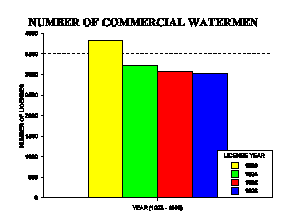
The deadline to renew your commercial registration license was
February 29, 1996. You must have your 1996 (black card) in order to purchase a
1996 commercial gear license of any kind.
The Commission will allow the experimental conch pot fishery to continue. A total of forty permits will be issued for 1996. Those watermen who held conch pot permits in 1995 and who reported accordingly will be allowed to have a permit in 1996. In addition, ten people who were on a waiting list will be issued permits.
There will be a public hearing on April 23, 1996 at VMRC, 2600
Washington Ave, Newport News to gather public comment on the following proposals
for the conch fishery:
1) Establishement of a 6-inch minimum possession limit on
channeled whelk harvested by conch pot.
2)Limitation of the harvest of channeled whelk from Virginia
waters to permitted conch-pot fishermen, licensed crab and conch
dredges.