We manage the state’s submerged bottom lands, tidal wetlands, sand dunes and beaches in order to preserve and protect Virginia’s natural resources and the habitat our saltwater fisheries depend on.
The Code of Virginia vests ownership of "all the beds of the bays, rivers, creeks and the shores of the sea within the jurisdiction of the Commonwealth, not conveyed by special grant or compact according to law," in the Commonwealth to be used as a common by all the people of the Commonwealth, and directs the Virginia Marine Resources Commission to manage those natural resources in tidal areas as a public trust.
In short, the Public Trust Doctrine is the principle that the state holds the land lying beneath public waters as trustee for the benefit of all citizens and is responsible for proper management of the resources on behalf of the public.
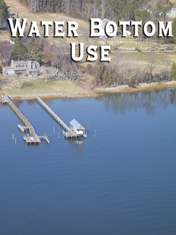
To do that, our Habitat Management Division handles permit applications for piers, docks, marinas, channel dredging, oyster grounds leases and the like — those activities that use, encroach on or disturb the water bottoms owned by the Commonwealth.
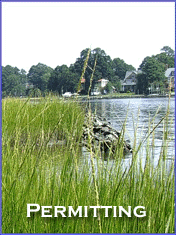
We also serve as a clearinghouse, sending copies of applications to other state or federal agencies that might have jurisdiction or issue related permits for a project. This streamlined permitting process saves citizens time and trouble by only having to fill out one Joint Application Permit.
Here are some general guidelines on what we do, and how we do it. Each project is different. They are treated on a case-by-case basis.
Please consult the Code of Virginia ( http://law.lis.virginia.gov/vacode/ ) and our Habitat Management regulations ( http://www.mrc.virginia.gov/regulations/ ) for specific information that may be pertinent to your project. Specific guidelines can be found there for uses of subaqueous lands, tidal wetlands as well as dunes and beaches.
When we receive applications, we solicit public comment on them, apply public interest factors in assessing them, and then prepare recommendations to the agency’s Commissioner or nine-member Commission for a decision.
Our Habitat Engineers are experienced, knowledgeable and helpful, and work to ensure wise and fair use of the water bottoms owned by all Virginians.
Applications are weighed on a case-by-case basis to determine if they are in the public interest, can reasonably be done with less impact on the environment, and if they meet legal requirements. Some fees, rents or royalties likely will be required, depending on the type and scope of a project.
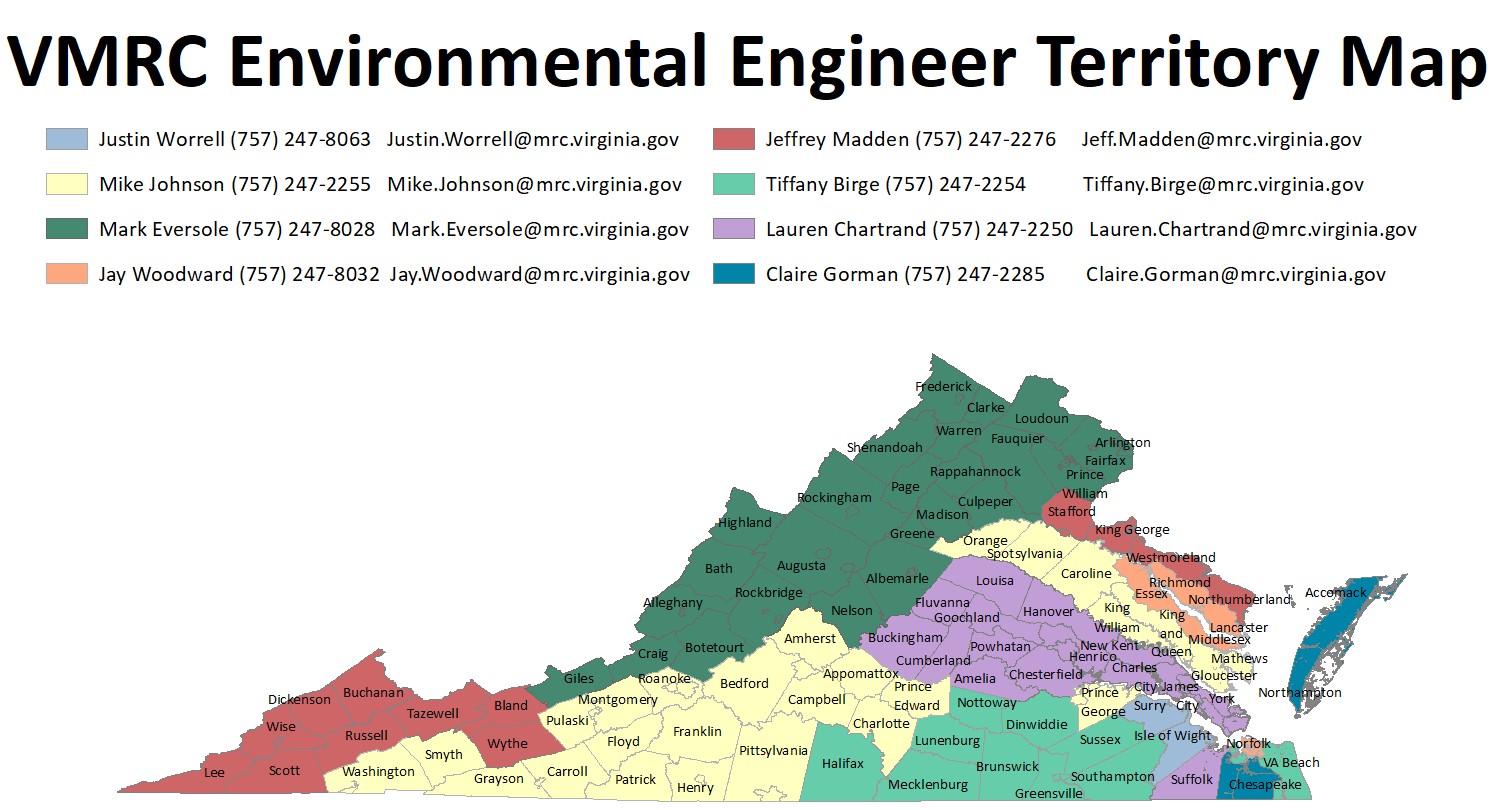
Habitat Engineers may recommend changes to either better a project or to mediate disputes with other user groups. Please keep in mind that seemingly simple projects can be complicated by navigation issues, property interest, neighbor objections, fish resources, presence of shellfish grounds and the need to preserved underwater grasses that are crucial habitat for many marine creatures. We can help with those issues. Joint Permit Applications, and instructions on filling one out, can be found at http://www.mrc.virginia.gov/regulations/hm-permits.shtm If you have a question for a Habitat Engineer in your area, you can click here territory assignments to see their territory assignments, phone numbers and email addresses. They would be happy to answer your questions. We also help localities administer their tidal wetlands program. Where no local program exists, we process tidal wetlands applications in the same manner for presentation to the Commission. Also, we lease water bottoms for the purpose of shellfish propagation. Our Engineering and Surveying Department can help you determine which grounds are available. It does the surveying, mapping and platting of those subaqueous grounds, and handles the annual rent charged for using them. That department can be reached at (757) 247-2225.
Click any ▶ line to expand the topic.
A. The Virginia Marine Resources Commission manages almost all the water bottoms (subaqueous land) as a public trust on behalf of all citizens of the Commonwealth. If you would like to use or disturb those water bottoms, such as to build a pier, dock, bulkhead or to dredge a channel or install a mooring buoy, you’ll need to fill out a Joint Permit Application and send it to us. We will act as a clearinghouse and send a copy to the other local, state or federal agencies that have applicable regulatory jurisdiction. The application, and instructions on filling it out, can be found here http://www.mrc.virginia.gov/regulations/hm-permits.shtm If you have a question about the permitting process in a specific area of the state, or the status of a particular application, you can click here territory assignments to see the territory assignments for our Habitat Engineers. They would be happy to answer your questions.
A. They are the submerged lands that begin at the mean low water mark, which is the average low water mark over the past 20 years.
A. That depends on a variety of factors, including navigation issues, proximity to the riparian rights of neighbouring waterfront property owners, the presence of leased oyster grounds, among other things. Each project is different. They are treated on a case-by-case basis.
As a general rule of thumb, waterfront property owners are permitted to build a dock with dimensions specified in the Code of Virginia, which allows piers that "do not exceed six feet in width and finger piers do not exceed five feet in width; any L or T head platforms and appurtenant floating docking platforms do not exceed, in the aggregate, 400 square feet."
You’ll need to fill out a Joint Permit Application. We'll review your proposal, and help you to work to make it the best that can be and ensure that it doesn't unreasonably interfere with others who wish the use the waterway.
A. Boat lifts and open-sided boathouses are permitted in some situations. They may be prohibited by local ordinance. Here's the law: subject to any applicable local ordinances, such piers may include an attached boat lift and an open-sided roof designed to shelter a single boat slip or boat lift. In cases in which open-sided roofs designed to shelter a single boat, boat slip or boat lift will exceed 700 square feet in coverage or the open-sided shelter roofs or gazebo structures exceed 400 square feet, and in cases in which an adjoining property owner objects to a proposed roof structure, permits shall be required.”
A. Each application is evaluated to determine if it is in the public interest. This is accomplished by ensuring that projects are necessary and there are no reasonable alternatives requiring less environmental disruption, and that negative impacts do not unreasonably interfere with other private and public rights to the use of waterways and bottomlands. The evaluation of proposed shoreline projects requires the balanced considerations of often complex environmental and economic factors.
A. Absolutely. The Virginia Marine Resources Commission manages tidal wetlands and reviews, and is empowered to review, the decisions of local wetlands boards.
Projects should have minimal impact on tidal wetlands. Any loss of tidal wetlands could require an applicant to replace them through construction of new wetlands, purchase of wetland credits from wetlands already constructed in a wetlands bank or possible payment to an in-lieu fee account established at the local, regional or state level and dedicated to wetland creation and restoration.
In order for a proposal to be authorized to destroy wetlands, a project must meet the following criteria:
1. All reasonable mitigating actions, including alternate design to eliminate or minimize wetlands loss or disturbance, must be incorporated in the proposal.
2. The proposal must clearly be water-dependent in nature.
3. The proposal must demonstrate clearly its need to be in the wetlands and its overwhelming public and private benefits.
The agency takes similar care in protecting coastal primary sand dunes and beaches, which also are ecologically important habitats, as recognized by the Virginia General Assembly in the Coastal Primary Sand Dune Protection Act.
State policy is to preserve these habitats as much as possible.
The Joint Permit Application can be use for tidal wetlands projects.